Dark Times
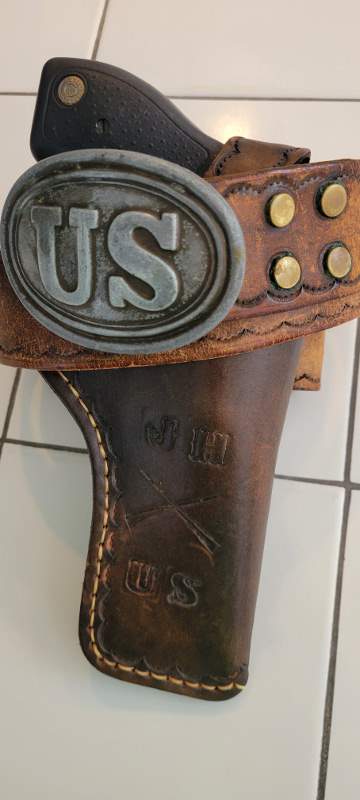
In the late summer of 1972, the combat action in the Highlands of Vietnam was winding down. It was also the rainy season which curtailed much of our flying. With some time on my hands, I went to a little craft shop that had been put together by some of the guys in the maintenance shop. It was a small room attached to one of the maintenance shops. I decided to make myself a gun belt out of leather complete with a holster that would hold a 38-cal. revolver. At that time, I carried a 45-cal. model 1911 handgun. I carried it in a western style gun belt that I bought on the local economy. I used that same set-up for both tours because I could pull and fire the weapon easily with one hand and the magazines allowed for a quick reload. The fact that it was a heavy piece of metal I could put between my legs gave me a sense (false sense) of security. When I got home, I liked wearing the belt without putting on the holster.
When I got back from my second tour in Vietnam, I was assigned to the University of Rhode Island (URI) to pursue a masters degree in sociology with a follow-on three year assignment as an ROTC instructor at the university. When I applied for the program, I was warned by my assignments officer that URI had been a hotbed of anti-Vietnam War activities by both the students and some of the faculty. I was told to keep my active-duty status and especially my Vietnam War service close hold while I was a student. I wore civilian clothes while attending classes and only a few faculty members knew that I was an active-duty Captain in the Army.
In the Spring of 1974, in my final semester of my master’s program, one of my professors hosted a cocktail party in his home. All the graduate students who were pursuing a masters degree in Sociology were invited to attend the party along with all the department faculty. The invitation included the wives of both students and the faculty. My wife Jean joined me that evening for the party. It was very pleasant and we were both enjoying ourselves when one of my fellow students, a woman, pointed at my belt buckle and asked if it was a military belt buckle. Before I could respond she asked if I had been in the military. I told her that yes, I was an active-duty Army officer. She came up to me and asked if I had been in Vietnam and when I said yes, she started yelling at me and cursing me with every profanity you could imagine. She accused me of being “a baby killer” and many other things. My wife was standing beside me while this woman verbally assaulted me. None of the faculty nor any of the students said or did anything to stop the woman or to come to my defense. My wife and I were shocked. I did not say anything to the woman, I just turned to my wife and said we’re leaving and we walked out.
That event has remained with us to this day. No one in the department ever mentioned it to me again. I was grateful that I was into my final phase of my masters degree curriculum and writing my thesis so I did not have to attend any more classes.
After completing my master’s degree at URI I became an ROTC instructor at URI in the mid-1970s. At that time, because of the Vietnam War, the social environment on campus was very negative toward the military and specifically toward the ROTC Department. There was talk from our headquarters of disestablishing the unit because of very low student enrollment.
As a captain, and later as a major in the department, I was responsible for recruiting students into the Program. I spent many evenings in the dorms and fraternity houses wearing my uniform trying to recruit students. It was a difficult time and I was verbally assaulted many times by students. Eventually, I was able to recruit an Army veteran named Paul Gurette who was a natural leader and a very popular student on campus. Because of his prior service he was able to enter the program as a junior. I had to promise him a flight training slot before he would join and that he could keep his long hair until he put on a uniform. Paul was able to influence other student leaders, both men and women, to join the program. We survived as a viable ROTC unit as a direct result of Paul's efforts.
I did get him a flight slot and he began training for his private pilot's license at the North Smithfield Airport in RI. At the time, it was the only flight training slot we could get. On February 4, 1977 during Paul's senior year, he died along with his instructor pilot in an aircraft accident at the airport. It was a tragedy for all of us, especially the young lady he was engaged to. At the time I was sure it would devastate our cadet corps and we would lose many students, especially the freshman and sophomore students, but thankfully, after a lot of sessions talking to the cadets, most stayed with us. They were dark times for all of us.
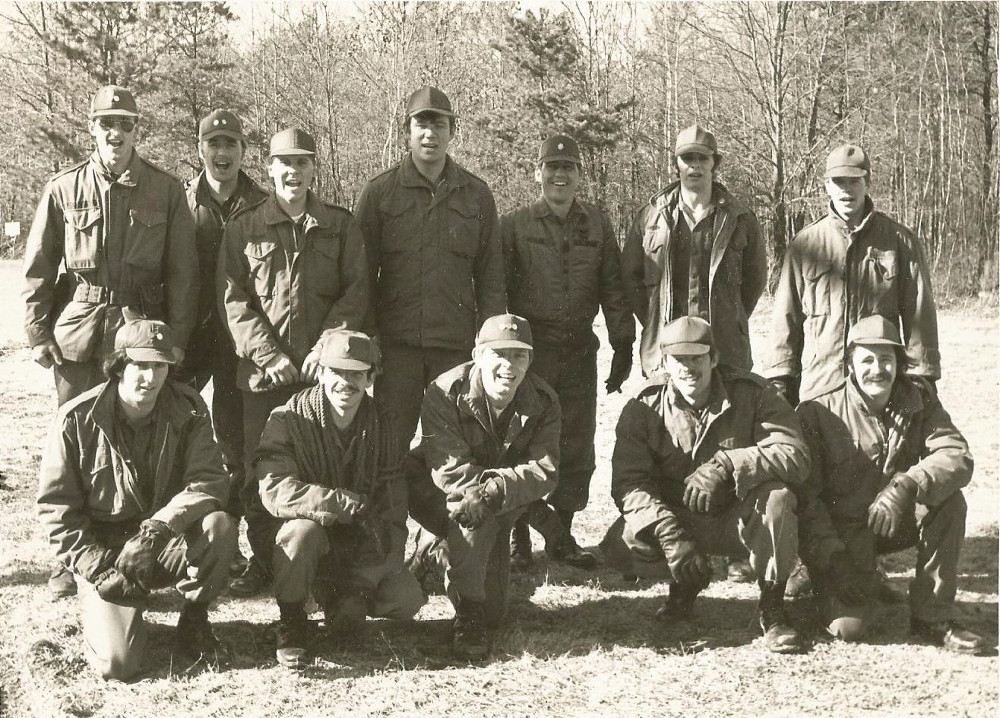
URI ROTC Students - Spring, 1976
Second row: 4th from left- Paul Gurette; 5th from left- Jack Heslin